Showing posts with label Right To Play. Show all posts

25 March 2010

Right To Play: Sefera Selam

In the Village, the Peaceful Village
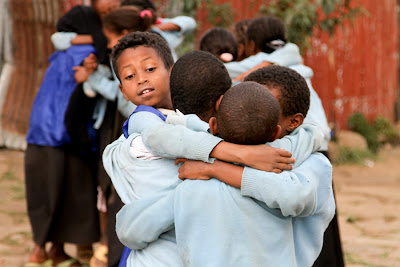
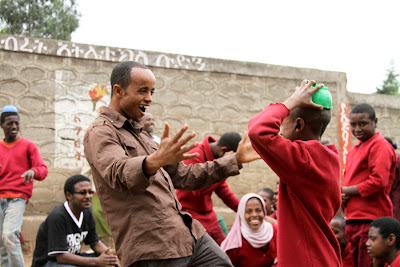
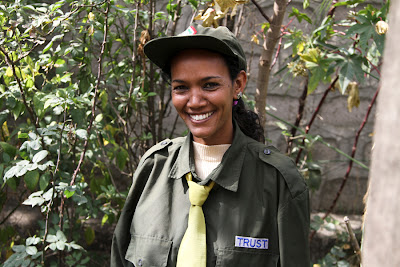
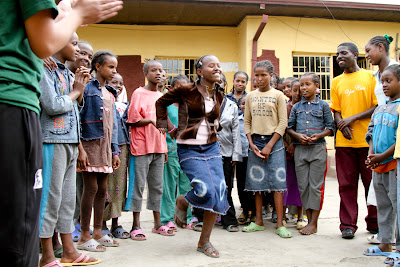
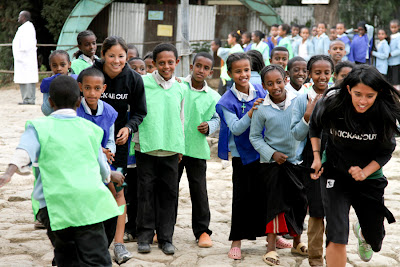
There is no fancy jungle gym here, just an open space with uneven cobbled ground. This is Sefera Selam, a primary school that sits in one of Addis Ababa’s most impoverished areas. Tons of kids fill Sefera Selam’s schoolyard to participate in this afternoon’s Right To Play activities. The equipment is simple: a couple of pieces of fabric, a few jerseys and some cones. Right To Play makes do with little to no apparatus, but the lessons are rich in values. Right To Play makes leaders.

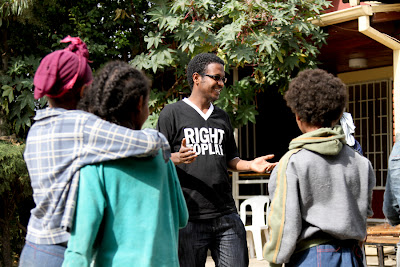
After a long day of school, the kids are wound up and revving to run. A few of the older, more responsible kids take the helm of this madness. They are Sefera Selam’s designated Right To Play Junior Leaders and have been selected for these positions because of their commitment to the program’s teachings. These four Junior Leaders take their duties very seriously. They help guide the younger participants through the day’s exercises, leading races and games of concentration and balance.
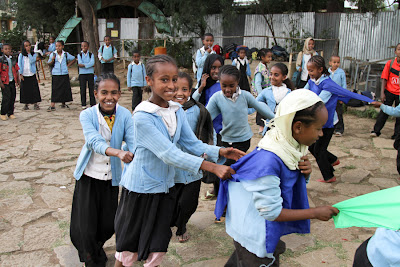
It is impressive to watch them keep the youngsters on task, but even more admiration is found in the way they facilitate the group discussions that follow each activity. Here they pause, opening the floor to the little ones’ opinions and thoughts regarding the games; now we hear the day’s take-away lessons applied.

There is nothing innovative about the idea of a role model. There is nothing technological or expensive involved in nurturing leadership. Right To Play’s vision is to create a healthier and safer world through the power of sport and play and it is doing so by teaching children to look after ones’ self in addition to looking after one another. Some believe it takes a village to raise a child. Here at Sefera Selam, which translates to the “village of peace,” children are raised by the village to, then, raise the village.
read more...

24 March 2010

Right To Play: Yekatit 23rd Special Needs

Clap Your Hands. Feel the Love.

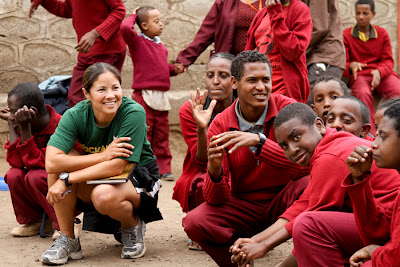
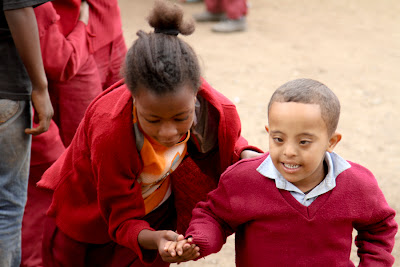
Amazing. Simply put, without exaggeration: amazing. There is no better word to describe the positive work that is being done at Yekatit 23rd Special Needs Primary School with the deaf and mentally disabled. The kids are so happy and enthusiastic and the energy and tactile support that the staff members give them in return is remarkable. There is so much hand holding, hugging, singing, signing, and kisses going on that it’s easy to forget that school is in session.

At this Right To Play site, the staff takes Right To Play curriculum and tailors it specifically to the needs of its children. These students are children who have different learning styles and physical abilities than those of the kids in the mainstreamed school and the customized application and adaptations have proven to be more successful in reaching this audience.

Right To Play lessons resonate with the students at Yekatit 23rd because they have been personalized to each individuals learning requirements; teacher’s animatedly sign for the hearing impaired, hold hands to guide those that require physical support, and offer up boundless energy to keep students engaged.

Team Kickabout’s favorite example of Yekatit 23rd’s interpretation of Right To Play's pillars is its use of the “love clap.” The “love clap” is a universalRight To Play action involving a series of claps, hand gestures, and blown kisses and it is used to wrap up a session. Yekatit 23rd Special Needs Primary School , however, chooses to use it when students find themselves in a disagreement. Following a tussle, the collective group offers the “love claps” for those that fought, encouraging them to put the exchange aside because they are friends who love each other.

In standard Right To Play fashion, Yekatit 23rd then partners a “reflect and connect” talk with the “love clap,” posing the question “what can we do to prevent fighting?” Right To Play uses “reflect and connect” discussions to have students apply daily lessons 1) to events from their past, 2) to the activity of the moment, and then 3) to think about how they can use it in a situation in the future. The students at this site participate in discussion to remind themselves and each other of simple ways to avoid conflict. For most of these kids, gentle reminders serve as preventative action.

Fighting aside, this particular program site is a love fest day in and day out. The staff members here are so involved in their students’ learning and parents verbalize how much they appreciate this. The teachers are caring and it’s obvious that the children love them back.

Six months of close quartered living in a Land Cruiser? Before things get too heated, Team Kickabout will be sure to “reflect and connect” on what we’ve learned from our friends in Ethiopia and pull out the “love clap.”

read more...

23 March 2010

Right To Play: Megenagna

Megenagna – As one of the poorest nations in the world, Ethiopia can be deceiving. There are signs of wealth everywhere, but off the paved main roads of the city there is a different story. Street children are everywhere. The reasons vary. Some leave to flee abuse, others are kicked out, while some leave in search of what they think is a better life. Whatever the reason, female street children face different dangers than their male counterparts.

“It is very possible to be raped, abused, or even killed,” says Yeshi, one of the 13-year old girls. Although most claim that they are 13, the truth is that many of them simply do not know how old they are. “And some of us have no family, so this is family.”

The family she speaks of is the sisterhood of around thirty girls that live at this orphanage in Megenagna (meg-a-NAN-ya). Coincidentally, the word megenagna means “meeting place,” and the girls, found on the street, are brought here by social workers to join OPRIFS. The main goal of the Organization for Prevention, Rehabilitation, and Integration of Female Streetchildren is to reunite them with their families and promote a healthy family environment. Their Behavioral Observation Plan identifies individual behavioral issues, and an external referral system is used as a supplement to ensure the girls can be treated for problems that OPRIFS does not have the expertise to handle. During their three to six month stay here at the orphanage the girls are given Alternative Basic Education, which includes AIDS/HIV education, leadership training, and social education through sport. It is the sport program we see today, and it is administered by an OPRIFS worker trained by Right To Play in their signature Red Ball Child’s Play module.

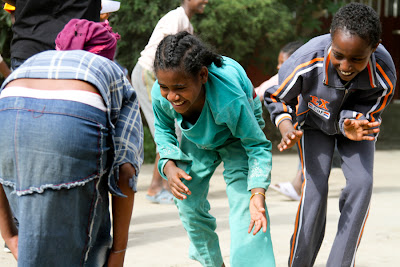
Upon arrival we are met by a stone-faced (she was all smiles when we departed) female security guard who lets us into the orphanage complex. The small area has a dorm, classroom, wash facilities, and of course a small open area to play. We greet everyone and two minutes later we join the girls in a warm-up game of tag and a follow the leader directional game. Trained youth leaders run group discussions about the life lessons associated with a series of games.

Gadise stands out, both as the strongest youth leader and for the tattoo on her jaw line, a distinguishing characteristic of the different rural communities in northern parts of Ethiopia. From beginning to end, she pays attention to everyone, making sure all the girls are active participants. It is clear that the girls care for one another and that the staff and youth leaders foster these relationships. Gadise believes that the girls must change their own lives. “God gave us this shelter. We must find families.” Knowing well that not all girls have blood relatives, she meant that every girl here must actively be involved in a family unit.

In what begins as an introduction to the Kickabout team, Ashley is prompted to demonstrate some West African dance that she has studied at the University of Minnesota. She is nervous at first, not wanting to mess up. But dance, like football, serves to connect and no common verbal language is necessary. Wonderfully, what she starts is a celebration of individual expression. (see below)

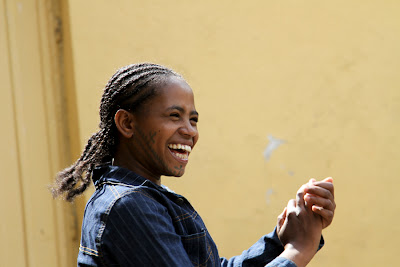
A dance circle forms, and different girls come forward to demonstrate their regional and tribal dances. Interestingly, the girls that dance are different than the girls that are verbal leaders or that dominate the games. There is no one way to lead, and this group appreciates the uniqueness of each individual’s leadership capabilities. They celebrate everyone, and afterward we break for tea and roasted barley, and get to know a little more about the man that cultivates this atmosphere.

Hussein Abamacha is the primary social worker here at the orphanage. Physically disabled, he was a street child himself before a social worker collected him from the street and sent him to get an education with an organization similar to that of OPRIFS. Hussein received training to be a teacher and then joined OPRIFS. Three years ago he was trained by Right To Play National Training Office, Melaku Tekola, in the Red Ball Child Play program. The once shy, quiet man lacking confidence now sports a bright yellow “YOU CAN” tee shirt.

“Through OPRIFS and Right To Play training I have learned a lot about myself. I use my training and communication skills to make relationships with others and help these children to have a better life.” With the sport development training he can also now do physical exercise with the children. Smiling, he explains, “I have forgotten about my physical disability.”

Hussein shines as a role model both for disabled Ethiopians and for the young girls that he teaches. He doesn’t see himself as a leader, but everyone else sees his personal success, love for his work, and determination to improve the lives of others as inspirational.

Eli puts it best when he explains to Hussein, “My friend…when you smile, the girls smile, the other staff smile, we smile, and then finally, the security guard even smiles.” Laughter ensues and we can only hope Hussein realizes how extraordinary he is.


March 18th, 2010
9th of Megabit (the 7th month), 2002
read more...

21 March 2010

11th of Megabit (the 7th month), 2002 *

After two weeks of camping in the 110 degree heat of the Nubian and Bayuda Deserts, it is easy to see how so many powerful armies perished trying to conquer all of Nubia. There are also the 3,000 year old tombs that still hold original colors and the untouched ruins of ancient temples and pyramids, some of which sit amazingly in people’s backyards. We are overjoyed with the exclusivity of exploring without the hoards of vacationers and hassling vendors that plague the more popular sites of neighboring Egypt. But far above everything in Sudan, we have fallen in love with the unprecedented hospitality of the Sudanese people. We imagine what it would be like if a group of Sudanese came walking through our yard and we halt everything to insist that they come in and spend the afternoon drinking tea with our families. There is a pang of sorrow with the realization that this is not a part of American culture. With that said, we cross into Ethiopia ready to start a new chapter in our journey.

After very little red tape and no police checkpoint at the border town of Metema we are in Ethiopia, home of the Ark of the Covenant, the source of the Blue Nile, and arguably the cradle of humankind. The official language spoken in Ethiopia is Amharic and it has its own unique script, with over 200 characters that denote syllables rather than letters. The traditional food here is injera, a large spongy pancake that is used to scoop stew, meat and vegetables by hand from a shared plate.

At the border we enjoy a quick lesson as we learn some important Amharic words like ‘hello,’ ‘goodbye,’ ‘diesel,’ ‘thank you,’ ‘water,’ and a few numbers. Immediately noticeable in speaking with the Ethiopians is a quick inhalation of air used in a similar fashion to our use of ‘uh-huh’ in conversation. After the brief introduction to the Ethiopian culture we start climbing towards Gondar and the southwestern edge of the Simian Mountains, one of Africa’s largest ranges and home of Ras Dashen, the highest peak in Ethiopia (4620 meters). Unlike Sudan, there are people and animals everywhere along the road. We are told by a pair of Brazilian travelers at the border that the three things to watch out for in the road are cows, donkeys, and children. It is soon apparent that the children have the most sense of the three when a car is approaching. Donkeys don’t care about anything, goats and sheep are erratic, and cows just cross with the masses. One thing is clear: the reason why it is a big no-no in every overland book to travel at night is because of the animals.

After seeing Lake Tana and a small, pre-rainy season Blue Nile Falls, we head south to the magnificent Blue Nile Gorge. The beauty of the drive can only be experienced fully over the 30 km stretch of road that drops from 2,500 meters to 1,200 meters and then back up the other side after crossing a small bridge over the Nile. We pay the price for the beautiful drive as the climb exposes some car issues that the level terrain of Sudan couldn’t.

Despite what other overlanders have told us, the yells of “Faranji! Faranji!” are not accompanied by hurled rocks. Perhaps we smile and wave before they can take any such action, or it is simply a case of an exaggerated tale…or maybe we are just lucky. In any case, our experience with northern Ethiopians is very pleasant.

After a few hundred miles of spectacular scenery (and a little car trouble), we descend upon the city that is the home of Lucy, the most famous 3.5 million year old skeleton, who was found in 1974. Even though she’s not the oldest remains ever unearthed, her notoriety is enough that we cannot see her at any point during our visit to Addis Ababa. And this may be the most disappointing thing about the entire trip thus far. No joke, she is currently on tour visiting none other than the United States of America.

It is difficult to imagine that a nation of such beauty is also one of the worlds poorest. The Prime Minister’s Palace, about half a mile up the hill from the President’s, overlooks the hills of Addis Ababa and the entrance gates of the immaculate Sheraton sit amid the shanties, making it seem like more of a monstrosity than an oasis. We take advantage of the fast Internet there, but we prefer the atmosphere of our little hostel in the Bole Road area on the other side of the city.

Before the arrival of our final Kickabout Africa 2010 team member, ‘Brain,’ we have two project sites to visit. We are spending three days with the orphans and street children of Addis Ababa through the programs of Right To Play and Sport - The Bridge.

* Of course the date explanation is saved for last as a special treat for those who have stuck out this diatribe. In 1582 when the Christian world dropped the Julian calendar for the Gregorian calendar, Ethiopia did not. So Ethiopia remains seven years and eight months behind what most of the world has come to see as the correct date. They have a 13-month calendar that begins on September 11th. What we find a little easier to wrap our heads around is the Ethiopian time. Their 24-hour clock starts at our 6am, which coincides sometime around sunrise. For the areas around the equator where the sunrise and sunset do not have a variable nature according to time of year, it is brilliant to begin the day with the sunrise.

read more...

16 February 2010

Kickabout: Right To Play Jordan

Though Kickabout: Africa 2010 officially kicks off in Egypt, after six weeks on the road we were itching to play some football, visit with coaches, and see some programs in action. We begged our friends at Right To Play for some stops in Jordan to help us warm-up - get the ball moving - and they more than obliged


Three days, five schools...this is Right To Play, Jordan.

8 February 2010
Irbid - Kickabout pulled up to the Karmel Club’s Community Center bright eyed and bushy-tailed, we knew we weren’t the only ones anxious to knock the ball around in our morning session. - Continue


10 February 2010
Zarqa - Kickabout encountered the first good weather of the long drive down, which came just in time for Eli’s 23rd birthday. The day really couldn’t have gone any better: two incredible groups of kids, two schools worth seeing, and too much birthday cake! - Continue


14 February 2010
Wadi Rum - A beautiful desert about 80 km north of the Red Sea port of Aqaba, Wadi Rum is a tourist hotspot where visitors can stay in Bedouin tents and venture out into the desert to see Lawrence of Arabia’s cave. It is also the site of the Disi School for Girls. - Continue


About Right To Play Jordan

Young people under the age of 29 represent 70 per cent of Jordan’s population. These children and youth experience the threat of poverty and unemployment, and lack of activities that provide respite from the difficult conditions they face in refugee camps and disadvantaged communities.

Right To Play’s intervention among refugee and disadvantaged communities in Jordan focuses on training teachers and staff of partner organizations to implement specially designed sport and play programs that provide psychosocial support, increase knowledge of healthy lifestyle behaviours, and provide youth leadership skills and opportunities for community participation.

Click to learn more about Right To Play, Jordan
read more...

16 February 2008

She Plays, We Play

14 February 2010 - Wadi Rum is a beautiful desert about 50 km north of the Red Sea port of Aqaba and a tourist hotspot where visitors can stay in Bedouin tents and venture out into the desert to see Lawrence of Arabia’s cave amidst an incredible landscape of towering rock formations.


It is also the site of the Disi School for Girls, a primary and secondary public school in this impoverished community. They are not refugees but Principal Suhad jumped at the opportunity last year to incorporate Right To Play’s Coach-to-Coach program into her school. As a psychology scholar, she doesn’t hesitate to express the importance of sport for development.

“This program reflects very well on the kids. One girl in particular, Bayan, was very stubborn and did not cooperate well with others. Now she has improved her ability to work in a team environment, but more importantly, she has improved in class as a student.”

We arrive just in time for Ms. Tammam, a 26-year-old English teacher and Right To Play coach, to begin a 45-minute program with a group of sixteen girls ranging in age from 13 to 15. A conservative community, hijabs are expected, while many teachers cover everything but their hands and eyes. Although we are dressed liberally in comparison, there are no judgmental or condescending glares, only warm faces and open hearts. After a warm-up game of tag, Ms. Tammam takes the girls through a series of stretches. We are here on football day, the favorite among both students and staff. The group is taught passing and after a couple of drills, every gathers together in a small circle. Before finishing the session with a big game, teamwork and attitude are discussed interactively.

When the game begins it is obvious that the passion for sport exists here at Disi School. What they lack in technical ability they more than make up for in athleticism, enthusiasm, and competitive spirit. But more evident is their appreciation for the opportunity to compete and be an athlete on a team. While most of the girls play with their brothers at home, this Right To Play program at school is the only other place they can play. After the session ends I ask the girls what they love about this program. While most say they like both the fitness aspect and the feeling of winning, all of the girls want to show that football isn’t only for boys.

Nariman, one of the 14-year-olds, simply says to me, “Football increases our ability to cooperate. I love the spirit of sport…and I also love the enthusiasm we have.” And their smiles all agree…

Before we leave Principal Suhad makes cardamom coffee for all of us and reflects on the session. She brought opportunity to the young girls of Disi School and with a gleam in her eye she says to me in perfect English that now she wants a teacher’s football class.

Return to Right To Play Jordan feature

read more...

We Never Outgrow our Right to Play

10 February 2010 - Right To Play’s motto is “look after yourself, look after one another”. During our time in Jordan, we have noticed kids taking care of one another. Be it older siblings feeding and cleaning the youngins’ or budding buddies walking to school hand-in-hand, there seems to be strong camaraderie that helps inch each another along.” It’s a good rule to live by and we’ve definitely seen this saying in action these last few days.

We arrived at Sukhneh Preparatory School and found a meticulously organized gym class of young ladies ready to play. These girls were happy to learn, giving each other (and Eli) high fives all around. They must take after their Right To Play-trained P.E. teacher, as she was the most openly athletic woman we’ve met in Jordan.

As a role model, she proudly exhibited her enjoyment of soccer as both a woman and an adult. Some find work and play difficult to juggle in their grown-up years, but this gym teacher finds simple balance by literally juggling - the soccer ball, that is.

Eli’s birthday festivities continued well into the day with a stop at Zarqa Preparatory School (where he got a surprise birthday song). The school, made up of over 1,000 Palestinian refugees, was an incredible example of community cohesion in action. These kids were a talented bunch in their own right, demonstrating glints of individual athletic aptitudes, but the Zarqa boys moved as a team and stopped to pick fallen teammates up off the blacktop. Right To Play coaches and school staff members looked on approvingly and jumped in when teaching moments arose. The greater student body crowded the asphalt to get a look at the game, some claiming spots on balconies and other high objects to get a bird’s eye view.

Those at Zarqa Prep were quick to adopt us as their own, celebrating Eli’s birthday as if they had known him since his day of birth.

How many 23rd birthday parties include a day full of recess?

Playing soccer all day long seemed fitting for Mr. Sinkus’ special day; everyone knows he’s a big kid at heart.

Aren’t we all?


Return to Right To Play Jordan feature
read more...

Irbid: Raring and Ready to Go

8 February 2010 - Our arrival in Irbid marked Kickabout’s first project site visit and the first opportunity to unload the lonesome goal posts we lugged atop our car throughout Europe. Apt to quell our soccer starvation immediately, Right To Play coordinated a day full of kicking about.

As we pulled up to the Karmel Club’s Community Center bright eyed and bushytailed, we knew we weren’t the only ones anxious to knock the ball around in our morning session. Boys in droves descended upon the large, open field to meet the Landcruiser. Throughout the day, we had the privilege of learning more about the Irbid community from Right To Play youth leader, Mr. Mahmoud Saïd. At first glance, we saw enthusiastic kids who were eager to play, and we asked why Right To Play was working in his community. Mr. Saïd spoke about providing a safe space for children to play and just be kids again. The community is made up of predominantly Palestinian refugees, and their access to healthy and positive lifestyle choices is limited.

Right To Play not only provides the boys and girls at the Karmel Club with a chance to play and learn, but also real opportunities to become leaders in their community.


Back on the pitch, Lorrie and Eli led a skills clinic where Lorrie, reprising her role as a Right To Play Athlete Ambassador, infused life lessons into the training activities. Within a few minutes, the boys of Karmel Club wanted to challenge Lorrie and Eli to a friendly match, anxious to play with a world-class athlete (and Eli).

At session’s end, Lorrie and Eli stumbled off the field riding a new found wave of adrenaline-fueled momentum with smiles on faces, sweat on brow, and reinvigorated from hibernation thanks to the energy of the boys.


The kids in the afternoon session were just as ebullient as our morning bunch, but faced an additional obstacle in getting the chance to play the world’s most popular game. They were girls. Showcasing a passion for football that rivaled if not surpassed the boys, we quickly noticed that our giddy group of female footballers was drawing quite an audience.

As our time together unfolded, it became apparent that females are still establishing themselves as accepted athletes within the culture. The high, protective walls of the playground became lined with little boys peeping within minutes. Standing on the fortification looking down on the girls’ training, these small onlookers did nothing to hide their curiosity, openly calling to other friends and brothers to join in a look-see.

A Right To Play coordinator could sense that we didn’t know what to make of the multiplying gaggle of boys and she explained that sportswomen remain somewhat of a spectacle. It is much more common to see males playing soccer and there is intrigue surrounding women in action due to the lack of exposure. The way these girls played – grabbing jerseys and celebrating goals on high?

Let’s just say that they could have had us fooled.

Return to Right To Play Jordan feature
read more...